

From Pastime to Paycheck: A New Gaming Era
Traditionally, gaming was a one-way transaction: players purchased games and in-game items while developers collected the revenue. However, blockchain technology is revolutionizing this dynamic. Enter the realm of Play-to-Earn (P2E), where players transition from mere consumers to active participants with the potential to earn real-world value. This innovative model rewards players for their time, skills, and dedication.
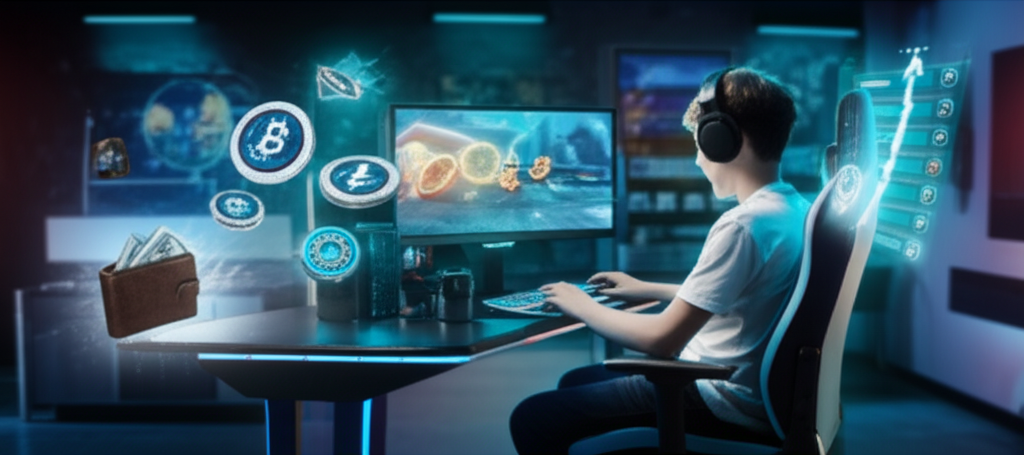
In this article, we delve into how blockchain technology is reshaping the gaming landscape. We’ll explore the mechanics of blockchain, the P2E economic model, and the exciting opportunities and challenges this digital frontier presents.
What Makes Blockchain Gaming Different?
Blockchain operates as a decentralized and immutable ledger system, leveraging cryptographic techniques to ensure data integrity and transparency. This system underpins the security and functionality of decentralized applications (dApps) in the gaming sector, introducing two groundbreaking concepts: true digital ownership and decentralization.
True Digital Ownership via NFTs
In traditional games, the items you “own” are essentially licenses to use within the game’s ecosystem. If the game ends or you lose access, so do your items. Blockchain introduces Non-Fungible Tokens (NFTs), unique digital certificates that verify ownership of an asset, making it independent of the game developer. This allows players to trade, sell, or use their items across different platforms.
Decentralization: Power to the Players
Most online games operate on centralized servers controlled by a single company. Blockchain enables decentralized platforms, promoting player-run governance through Decentralized Autonomous Organizations (DAOs). This democratizes game updates and policies, making the ecosystem more resilient and player-driven.
The Play-to-Earn (P2E) Economic Engine
The P2E model integrates NFTs and cryptocurrencies to create a sustainable in-game economy. Here’s the typical cycle:
- Play: Engage in gameplay activities such as completing quests, winning battles, or crafting items.
- Earn: Players earn in-game assets, like NFTs or fungible tokens (the game’s cryptocurrency).
- Trade: These assets can be sold or traded on open marketplaces for cryptocurrency.
- Cash Out: Convert cryptocurrency into traditional money on a crypto exchange.
Case Study: The Rise and Lessons of Axie Infinity
No game better exemplifies the P2E phenomenon than Axie Infinity. In 2021, the game reached over 2 million daily active users, generating over $1 billion in revenue. It became a primary income source for many, especially in developing countries. However, Axie Infinity also faced challenges, including a $625 million hack on its Ronin bridge in March 2022, highlighting the vulnerabilities in its economic model.
“Thanks to P2E, I’ve managed to support my family and fund my education. It was more than just a game; it was a lifeline.” – John Smith, a full-time Axie Infinity player from the Philippines.
The Major Hurdles on the Blockchain Frontier
Despite its promise, blockchain gaming must overcome significant challenges for mainstream adoption. Issues such as scalability, high transaction costs, security risks, and regulatory uncertainties persist. Additionally, there’s a need to balance financial incentives with engaging gameplay, prompting a shift towards a Play-and-Earn model.
The future of gaming is intertwined with digital economies, with blockchain poised to play a pivotal role. The question isn’t if blockchain will influence gaming, but how profoundly it will shape its future.
How does blockchain technology enable true digital ownership in gaming?
Blockchain technology enables true digital ownership through Non-Fungible Tokens (NFTs). Unlike traditional games where items are mere licenses, NFTs provide a verifiable certificate of ownership recorded on the blockchain. This allows players to sell, trade, or use items across different platforms, independent of a game developer’s control, similar to owning physical assets.
What are the key advantages of decentralization in blockchain gaming?
Decentralization in blockchain gaming shifts control from centralized servers to the players themselves. This empowers players through decentralized platforms where they can participate in governance, such as voting on game updates and economic policies. This democratic approach fosters resilience and transparency in the gaming ecosystem, potentially leading to more equitable and player-driven gaming experiences.
What challenges does the Play-to-Earn model face in blockchain gaming?
The Play-to-Earn model faces several challenges, including scalability and high transaction costs, security risks like hacking, economic instability due to inflation, and regulatory uncertainties. Additionally, the focus on earning can sometimes prioritize financial incentives over engaging gameplay, leading to a shift towards a Play-and-Earn model that aims to balance fun and earning potential.
Why is Axie Infinity significant in the context of Play-to-Earn gaming?
Axie Infinity is significant as it exemplifies the potential and challenges of the Play-to-Earn model. It became a primary income source for many, particularly in developing nations, showcasing P2E’s economic impact. However, its reliance on new players and a major security breach highlighted its vulnerabilities, serving as both a success story and a cautionary tale for P2E economies.